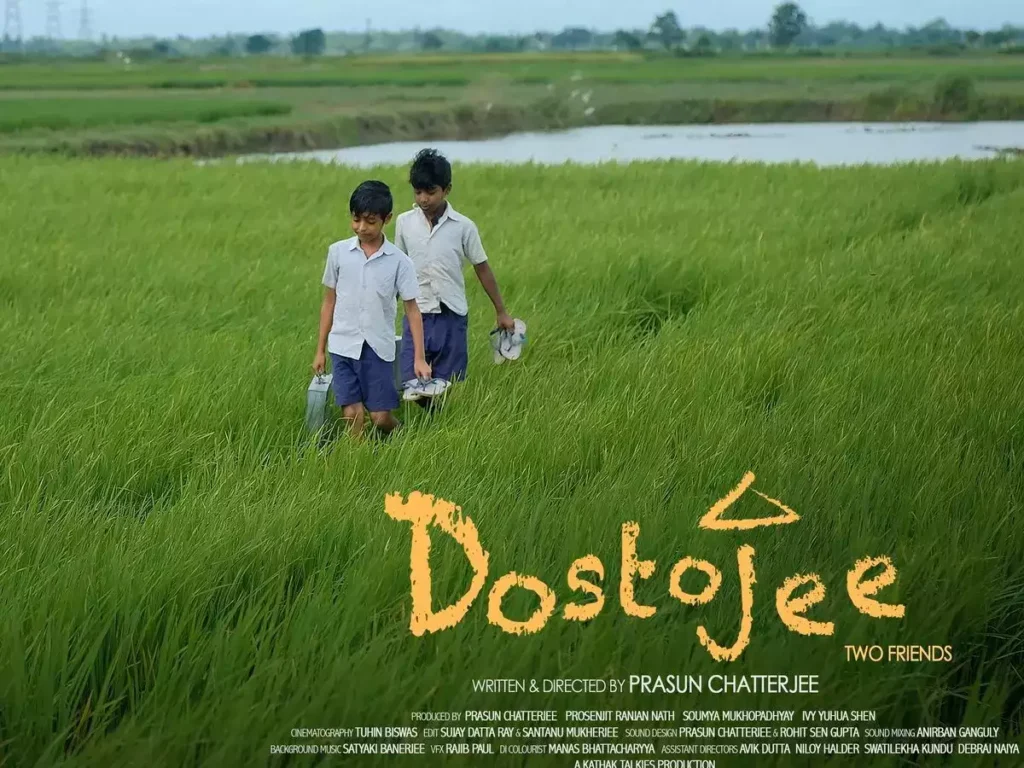
Dostojee is a Bengali language movie set in the backdrop of 1990s and shows the innocent friendship of two children: one belonging to Hindu Community and other belonging to Muslim Community. The movie is set in the region near Indo- Bangladesh border in areas of Domkal subdivision of Murshidabad district in the state of West Bengal.
The movie beautifully and poignantly shows the emotional turmoil and nuisances of day-to-day life in a society driven by communal sensitivities. The main theme of the movie is the innocence of friendship and how loss of a life affects different people in different ways.
“Dostojee” is a Bengali word which means friend. The two-child actor Safiqul played by Arif Shaik and Palash played by Asik Shaikh share a unique bond. They are unaware of their religious intricacies and share a friendship which goes beyond the restrictions of religions. The movie is set in the time of demolition of Babri masjid and 1993 Bombay blasts. These twin events shattered the religious co-existence of both major religion in India, making these two religions vulnerable to each other in areas of their dominance. In the movie, Hindus are a minority in the region where this movie is taking place. The communal tension can be seen in the movie by acts like making of a mini Babri masjid by Muslim communities and playing of Ramayana stories by Hindu communities. Both communities are trying to establish their religious identities and dominance and this creates divide on religious lines.
In the movie, both children have their houses nearby, just separated by a wall made of bamboo. Safiqul and Palash go to school together, play together and have only each other.
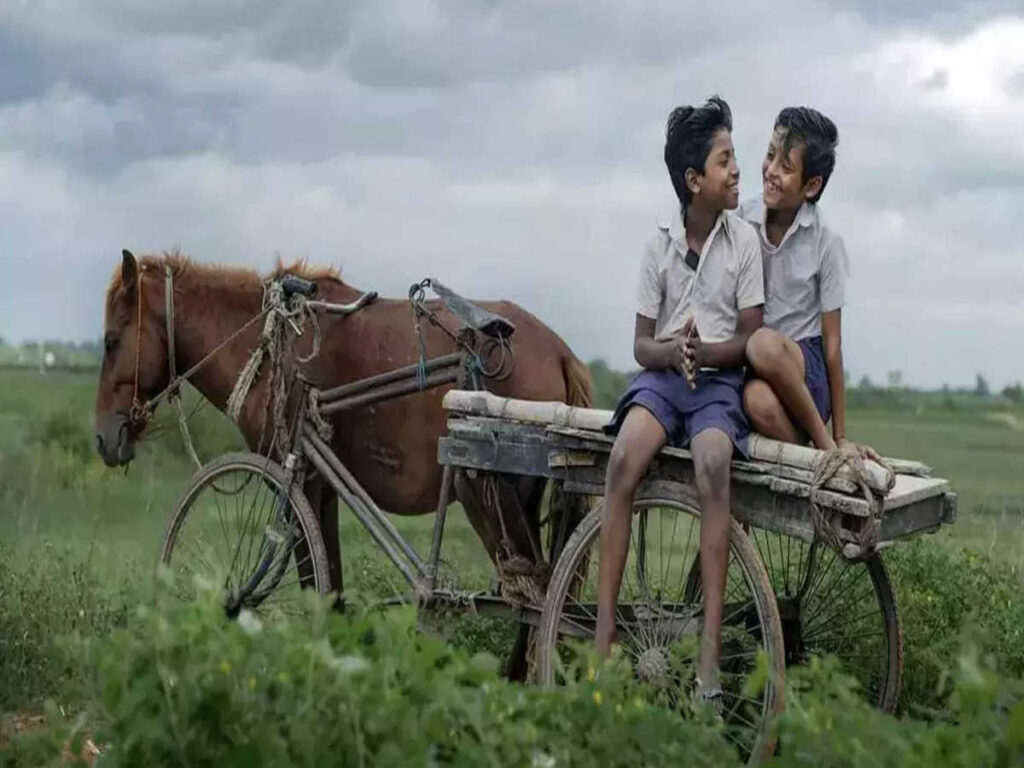
There are many wonderful scenes which need to analyzed to understand how well Dostojee reflects the nuisances of friendship and relationships.
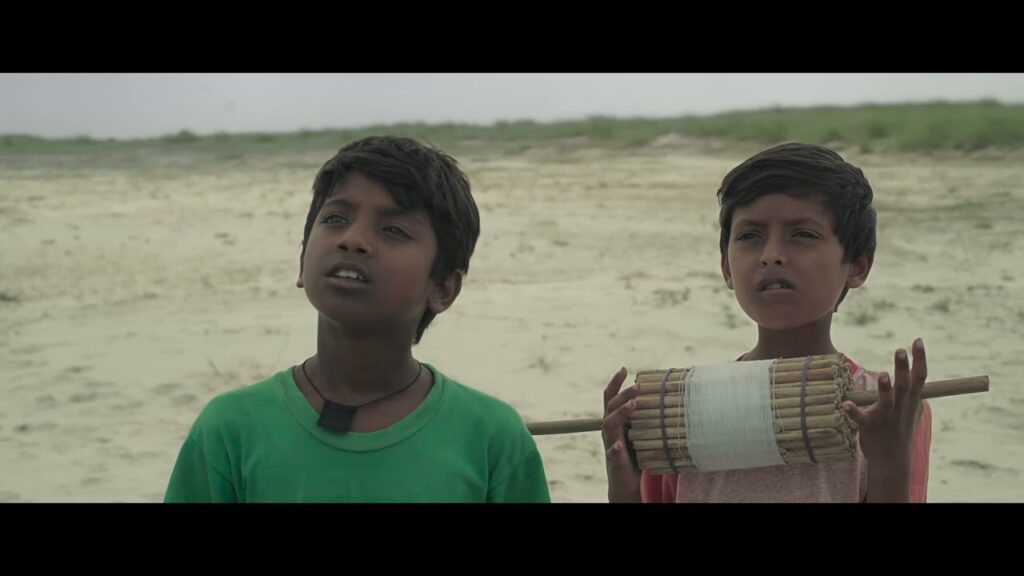
There was one particular scene where both boys are out near a dried riverine flying a blue kite. The blue kite was bought by Safiqul which gets torn when Palash was holding it. This creates a rift between the two boys. Safiqul stops talking to Palash. Palash finds it too difficult to live without the friendship of Palash. When days after days go like this Palash tries to make truce by getting the blue kite using his commute money. He goes to school on foot so that he can save the fare and buy the blue kite. This was so heart warming and at the same time very poignant and innocent scene.
Dostojee is the mélange of such poignant scenes.
For me, the most heart-wrenching and the significant scene was when mother of Palash cries once the caterpillar she and Safiqul were feeding turns into Projapati (butterfly). This was a symbolic scene in which the only thing mother was holding was that caterpillar which both the boys used to raise together. In her cry we all felt that pain. This was way more painful than the way the drowning scene of Palash was shown. In her cry we felt the pain of a mother holding to the last memories of her child.
Not only mother, Safiqul himself is processing the loss of his friend in his own way. He tries to create a design which will help humans get oxygen in water. This is a way for him to find a way to get to his friends and his unconscious longing and wish that if only there had been such a solution, his best friend Palash would have not died due to drowning.
After death of Palash, Safiqul is now more serious in studies. When both boys used to study together, Safiqul will always get an earful from the Tutor due to lack of seriousness in studies while Palash was very sharp in studies. In absence of Palash, Safiqul is trying to find him by imitating what Palash used to do in studies.
All the small incidences have been portrayed so effortlessly and with such an ease without being preachy about how much Safiqul is missing Palash.
In the last scene, Safiqul is finding his friends by matching the sound of Cuckoos in the garden and near that tree where both boys had sketched a love sign showing how much both loved each other. This was such a powerful portrayal of friendship.
Dostojee will always be remembered for its wonderful depiction of child friendship. At some point you are remembered of the famous Apur sansar movie by legendary Satyajit Ray. I am sure after years this movie will also be counted as classic for its wonderful script, acting and cinematography.


There are some other aspects which are worth mentioning.
The movie shows how society creates religious identities and makes one communally aware by slow habitualization of religiously insensitive behaviors. In one of the scenes where both boys were making a structure for lord Rama in the house of Palash, Sariful asks for water to the sister of Palash. She is a small girl of age 5-6 unaware of any religious separatism. When she goes to her mother and asks for water by picking up a steel glass and showing her to give water, the mother asks her to leave that glass and says that there is a separate glass for Sariful. She goes and picks up that glass which is lying isolated and is used only for giving water to Sariful. This comes from the concept of purity and fear that by mixing utensils my religion will become spoiled and I will lose my religious purity. This is nothing but social construction of religious divide for the innocent children belonging to different communities. This is what ruins a childhood and turns beautiful innocent child into bigot. Those who are sensitive enough will realize the futility of such practices, but majority will be doing this as part of their growing up and fitting into the society practice.
Dostojee is a movie which shows all these small things which ultimately have a big impact in the way we live our life. This movie is also a gateway to India of 90’s and especially for a rural Bengal. This movie will become a classic eventually and that should be one of the reasons why you should watch this internationally acclaimed movie.
Leave a Reply